Backyard Pool Safety and Drowning Prevention

Children love to play in water. Yet, children and bodies of water can be a dangerous combination. Nationally, drowning is the second cause of unintentional injury-related death among children ages 1 to 14.

 

Drowning can happen wherever there is water. And, in Florida, water is everywhere – canals, lakes, oceans, backyard pools, and even bathtubs. The most common place where drownings occur is in backyard pools. Sadly, these events often happen when adults are nearby – distracted by their devices or other people.

Our Community Partners

In an effort to prevent drowning, Nicklaus Children's Hospital, the YMCA of South Florida, Miami-Dade County Parks and Recreation, NBC 6 and Telemundo are collaborating to promote water safety.

Be a Water Watcher

The most important action one can take to protect children is to ensure they are attentively supervised when in or near water. That means an adult is constantly watching the child or children without distraction from tablets, smartphones, book, or other adults or children. Remember, drowning is a silent event and can occur within a matter of seconds.

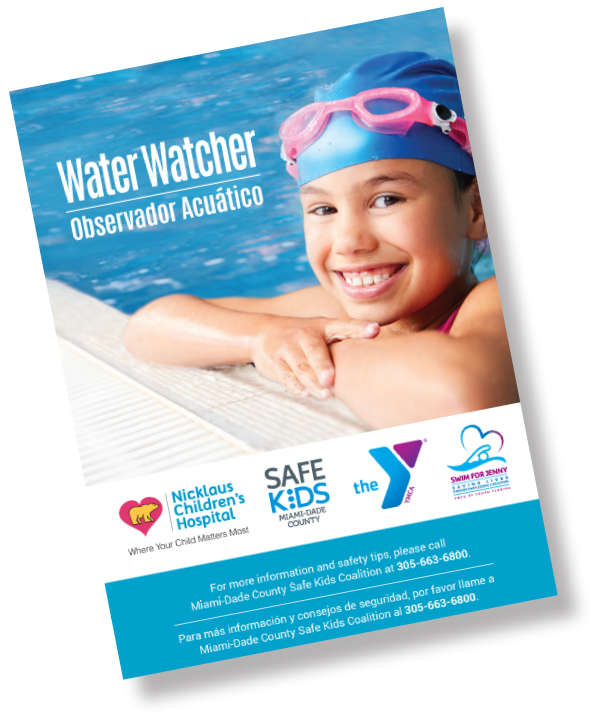
Our Water Watcher card can be handed from adult to adult, to serve as a physical reminder as to who is the designated watcher. To request your Water Watcher card, click below.
  Get Your Water Watcher Card

Water-Watcher-Badge.jpg


Use Alarms During Swim Time

No matter how careful you are, it only takes a moment to lose sight of your kids. That's why one should ensure alarms and barriers are the next layer of safety to protect children. Install active alarms on doors leading to the outside so kids can't slip out without your knowledge.

Ensure you also have barriers around your pool or property if you live near water. That means property fences, pool fences, and even pool alarms that alert you to moving water when no one should be in the pool.

Family-beach-day.jpg

Drowning Prevention Tips

  • Actively supervise children every time they are in or around water. Don't leave or look away, even for a moment.
  • Use barriers (fences, pool covers, pool alarms) to keep kids away from water when you're not around. After use, empty buckets, tubs, and wading pools.
  • Teach children never to go near a pool drain and to pin up long hair when in water.
  • Everyone should know the water safety rules. No swimming alone!
  • Make sure children take swimming lessons. But even those who have taken swim lessons should be supervised while in or around the water. Accidents can and do happen.
  • Learn CPR and keep rescue equipment (like a life-saving ring), a telephone, and emergency phone numbers poolside.

Learn more about drowning prevention and visit RedCross.org for additional CPR Training.


Swimming Lessons in Your Community

Both the YMCA of South Florida and Miami-Dade County Parks and Recreation offer swimming instruction at a wide range of locations. For YMCA locations visit below.

Locate YMCA of South Florida Swimming Lessons

For locations in Miami-Dade County Parks, please click below.

Locate Miami-Dade County Parks Swimming Lessons

Additional Water Safety Resources

Weight Management for Children and Teenagers

January 14, 2020 – Obesity has become one of the most significant threats to the well being of our nation’s children. It is estimated that nearly 32 percent of children and adolescents are overweight and that 16 percent or more can be categorized as obese.

Sports Nutrition in Kids and Teens

May 13, 2019 – Exercising and being active is only half the battle. In order for children and adolescents to have the best chance at becoming successful athletes they need to fuel their bodies appropriately. A common misconception is that because a child may be very active, he or she can eat anything because it will burn off in practice. While the child may burn many calories in practice or competition, he or she will not be playing at an optimal level if health foods are not being consumed.

Recommendations for juice consumption in children

March 29, 2019 – Consumption of fruit juice has increased drastically within recent years as children and adolescents continue to be the highest consumers. An excessive amount of juice consumption can lead to not only an increase in calories, but also an increased risk for childhood obesity and dental caries.

Immune “Boosters” for Children

March 27, 2019 – A healthy immune system is your family’s best weapon to fight the common cold or the flu season, and our job is to keep you ready. Below is a list of six immune-boosting nutrients and the different foods they can be found in, recommended by Nicklaus Children’s Hospital’s #GiveMe5 program. 

Child-Friendly Veggies

March 05, 2019 – Vegetables are an important part of a healthy diet, but getting kids to eat an adequate amount can be challening. Here are helpful tips to introduce more veggies into a child's diet. 

Sports Hydration Infographic

June 06, 2016 – How much water should a kid drink while playing sports?

Healthy Tips for Kids Infographic

June 25, 2015

Healthy, happy kids grow up to be healthy, happy adults. It’s a parent’s responsibility to instill good habits early on. Read on for more healthy tips for kids about eating nutritiously, spending time outdoors, clocking enough sleep, limiting screen time and staying fit and active from childhood to adolescence and beyond.

Sugar Intake in Kids Infographic

January 04, 2015 – It's no secret that kids love sugar. What's unclear is just how detrimental the sweet stuff is to your child’s health. Recent studies have found that sugar has the same effect on the brain as certain addictive drugs. The experts at Nicklaus Children's Hospital take a closer look at the harmful effect too much sugar can have on the body.

Nutrition and the My Plate Food Guide

November 03, 2013 – At all stages of life, nutrition plays an important role in maintaining good health. It is important not only for growth and development, but to maintain strong bones and teeth and build a good immune system.