


Amplatzer Piccolo Occluder
Also known as: patent ductus arteriosus (PDA) closure, transcatheter PDA closure, non-surgical PDA closure
What is Amplatzer Piccolo Occluder?
The Amplatzer Piccolo Occluder is a treatment for the congenital heart defect known as patent ductus arteriosus (PDA). Infants born with PDA have an abnormal opening between the aorta and pulmonary artery that can cause circulation problems. The opening is a normal part of a baby’s circulatory system before birth, but it usually closes shortly after birth. The Amplatzer Piccolo Occluder is a device used to close this opening in premature babies that can be installed with a catheter and without surgery.
What happens during the procedure?
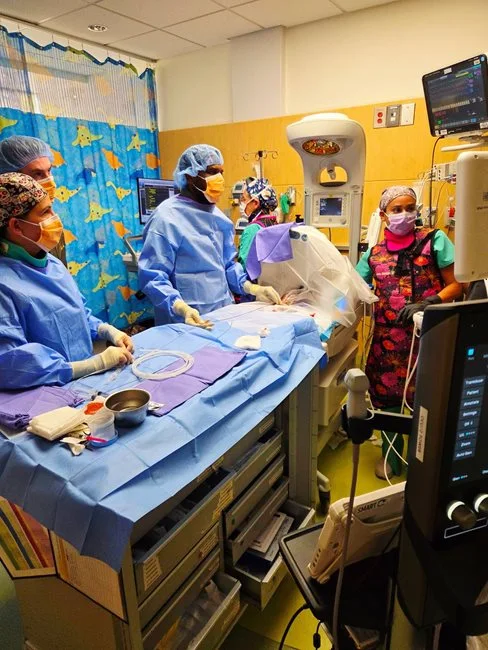
A tiny incision is made in the baby’s leg, and a guidewire with the Amplatzer Piccolo Occluder attached is placed into the body’s blood vessels through the opening. The wire is then guided to the baby’s heart through the blood vessels, where the occluder seals the PDA. Fluoroscopy and echocardiography are used to guide and position the occluder in its proper position in the PDA.
Is any special preparation needed?
The Amplatzer Piccolo Occluder is recommended for very premature babies with a low birth weight and the need for respiratory support. It is performed under general anesthesia. For babies who are good candidates for the procedure, no other special preparation is needed.What are the risk factors?
Potential risks of the Amplatzer Piccolo Occluder include bleeding, infection or movement of the occluder. It is also important to make sure the device is not blocking flow into the surrounding vessels, which can be checked with an echocardiogram before the device is released.
Reviewed by: Lourdes Rosa Prieto, MD
This page was last updated on: 4/22/2026 11:51:50 AM
Heart Institute
The Heart Institute – a world leader in pediatric cardiology and cardiovascular surgery and the care of children with congenital heart disorders – serves as a beacon to families confronting the reality of a child or newborn with a heart defect.
Learn MoreCardiac Catheterization Laboratory
Recognized as a world leader in interventional cardiac catheterization. Our Cath Lab utilizes the latest innovations in imaging and catheter device technologies, our philosophy of high-tech meets high-touch is evident in every aspect of care.
Learn MoreRelated Clinical Trials
Related Press Releases
Use the symptom checker tool to check how serious your symptoms are, if a healthcare visit is needed, and what steps you can take to relieve your symptoms at home.